Practical guide · NOC operations
AI incident triage for NOC operations.
A practical framework for turning a flood of alerts into a grounded incident narrative, a ranked investigation path, and a safe next step—without removing the operator from the decision.
Direct answer
What is AI incident triage in a NOC?
AI incident triage in a network operations center is the use of operational telemetry and machine reasoning to group related alerts, gather context, rank probable causes, identify affected services, and recommend the next diagnostic or response step for an operator to review.
The goal is not to produce a clever paragraph. The goal is to help the operator answer five operational questions faster: What changed? What is affected? Which evidence is relevant? What is the most plausible cause? What should we verify next?
Useful output
A triage result should contain:
- A concise incident summary and time window.
- The affected services, sites, devices, links, or users.
- The evidence used and important healthy counter-evidence.
- Ranked hypotheses with confidence and uncertainty.
- A bounded next action that an operator can approve or reject.
Data foundation
AI cannot triage what the NOC has not structured.
A model needs more than alert text. It needs normalized facts that share timestamps, asset identities, service relationships, and operational scope.
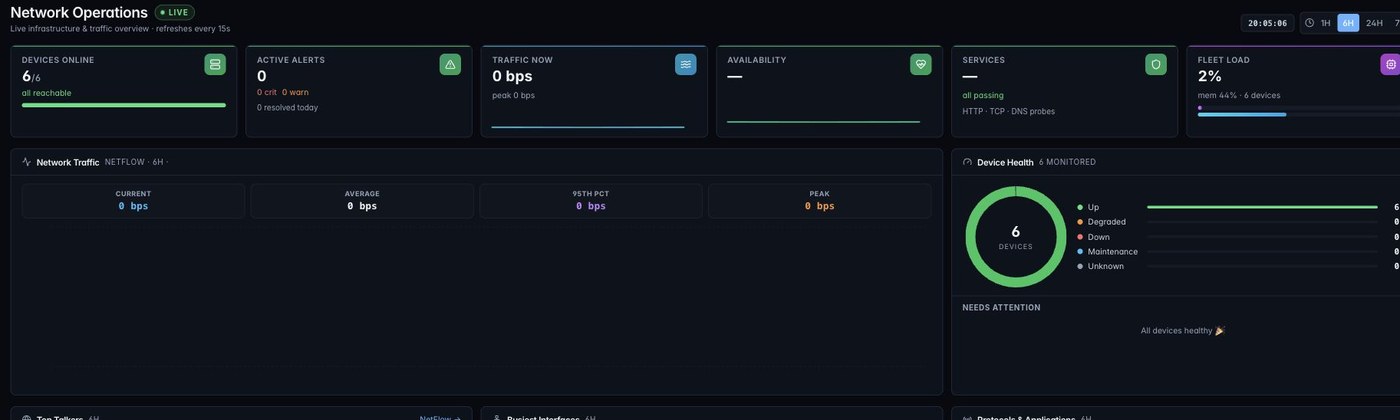
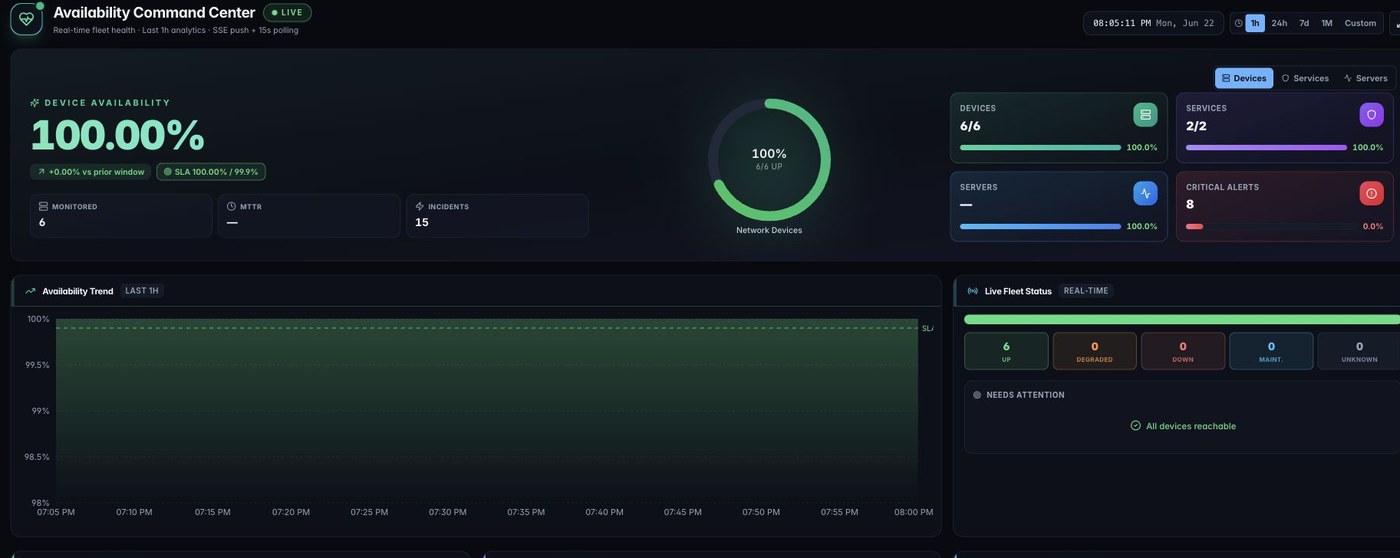
Health and availability
Device reachability, service checks, latency, packet loss, interface state, utilization, and recent outages establish what is failing and when it began.
Traffic and application behavior
NetFlow conversations, top talkers, protocols, traces, service dependencies, errors, and response times show how an incident moves through the environment.
Change and event evidence
Alerts, traps, configuration state, firewall logs, topology, maintenance windows, and operator history help distinguish a cause from a coincidental symptom.
From noise to action
A seven-step AI incident triage workflow.
Each step should produce a visible artifact that the next step can use and an operator can inspect.
Normalize the incoming signals.
Put alerts, events, traps, service failures, and anomaly signals onto a common timeline. Preserve source, severity, asset, site, service, and first-seen time.
Group related symptoms.
Collapse duplicates and relate signals that share time, topology, dependency, or change context. Keep the original evidence accessible instead of discarding it.
Define the blast radius.
Identify affected sites, services, devices, interfaces, applications, and user paths. Also name what remains healthy; healthy neighbors can eliminate weak hypotheses.
Collect the missing context.
Pull the relevant availability, utilization, flow, trace, topology, configuration, and log evidence for the incident window rather than loading every available metric.
State probable causes as hypotheses.
Rank explanations by the evidence they fit, the evidence they do not fit, and the fastest safe test that can separate one hypothesis from another.
Propose one bounded next step.
Recommend a diagnostic, escalation, communication, or recovery action. Name prerequisites, expected evidence, risk, and who must approve execution.
Preserve the decision trail.
Record the summary, evidence, hypotheses, operator decision, action result, and final cause. This turns incident history into better runbooks and evaluation data.
Worked scenario
Hypothetical example: a degraded branch site.
Assume several devices at one branch become intermittently unreachable while users report slow access to a business service. This example illustrates the reasoning pattern; it is not a claim about a specific customer incident.
1. Compress the symptom set
Group the reachability alerts, service-check failures, packet-loss changes, and interface warnings that began in the same time window.
2. Establish scope
Confirm that the branch WAN path and dependent service are affected while neighboring sites and unrelated services remain healthy.
3. Compare evidence
Review interface errors and utilization, latency, top conversations, recent traps, route or configuration changes, and application traces for the affected path.
4. Recommend the discriminator
Propose the lowest-risk diagnostic that distinguishes congestion, link quality, device resource pressure, and application failure before recommending remediation.
Control boundary
Assistance is not permission to execute.
An AI system may be able to suggest a command, configuration change, failover, restart, route change, or policy update. That capability does not establish that the action is safe or authorized.
- Separate evidence gathering from state-changing actions.
- Require explicit approval for consequential changes.
- Limit actions by role, asset scope, and approved runbook.
- Show the exact proposed action, expected outcome, and rollback path.
- Record approval, execution result, and any operator modification.
Evaluation scorecard
Measure decision quality, not word count.
Start with replayed incidents and shadow-mode suggestions before allowing any operational action. Track whether the triage output helps an operator reach the next correct step.
- Evidence precision: relevant facts cited versus distracting facts included.
- Scope accuracy: affected and healthy entities identified correctly.
- Hypothesis quality: plausible causes ranked with uncertainty.
- Action usefulness: operator accepts or improves the proposed next step.
- Audit completeness: another operator can reconstruct the decision.
Zentryc implementation
How ZenAI maps to this workflow.
ZenAI is designed to reason over structured Zentryc telemetry inside the customer environment: devices, availability, interfaces, NetFlow, services, traces, maps, alerts, configuration state, and reports.
It uses that context to prepare incident summaries, probable-cause paths, impact scope, and explicit recommended actions. Role-aware workflows keep a human responsible for deciding what executes.
Common questions
AI incident triage, answered clearly.
What is AI incident triage in a NOC?
It uses operational telemetry and machine reasoning to group related alerts, gather context, rank probable causes, identify affected services, and recommend the next diagnostic or response step for an operator to review.
What data does AI need for useful NOC incident triage?
Useful triage needs time-aligned device and service availability, interface health, topology, flow records, application traces, active alerts, configuration state, log events, and recent operational changes.
Should AI automatically remediate every network incident?
No. Consequential actions should remain explicit, permissioned, and reviewable. AI can explain and recommend while an authorized operator decides what executes.
How should a NOC evaluate AI incident triage?
Evaluate evidence quality, alert compression, scope accuracy, hypothesis usefulness, time to the next correct diagnostic step, operator acceptance, auditability, and safe handling of actions.
See the workflow on your telemetry
Move from alert volume to accountable incident action.
See how Zentryc structures monitoring data for on-premises, AI-assisted operations while keeping your operators in command.